Frequently Asked Questions About Roofing in Clapham
Content last reviewed: September 2026.
The questions below cover what Clapham customers ask us most often.
How quickly can you attend a roofing job in Clapham?
We aim to carry out an on site assessment within two working days for standard repairs across Clapham and the rest of SW4. For storm damage or an active leak we offer emergency callout and try to attend the same day. Clapham is a core part of our South West London round, worked alongside Battersea, Brixton and Stockwell, so it is planned for rather than treated as an outlying area. Once we have inspected the roof we confirm a schedule for any follow up work, so you know when the job will be finished.
Which parts of Clapham and SW4 do you cover?
We cover every street in Clapham and the full SW4 postcode, from Old Town, The Pavement and Rectory Grove to Abbeville Village, Clapham High Street and Clapham Park. We also cover the streets around Clapham Common that cross into SW11 and SW12 in the London Borough of Wandsworth, and Battersea, Brixton, Stockwell and Wandsworth nearby, so a job near a postcode or borough boundary is not a problem. Our roofers travel out to SW4 for every job, we do not subcontract Clapham work to a third party roofer working under our name.
Why is my loft conversion roof leaking in Clapham?
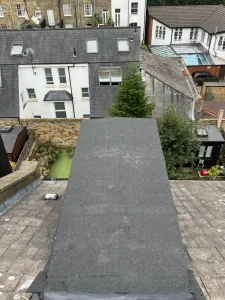
A mansard or rear-dormer loft conversion replaces part of the original slate roof with a new structure that has to be tied back into what remains. The leak usually starts at that junction: the flashing where the dormer cheek meets the old slope, the felt or membrane on the flat top of the dormer or mansard itself, or a concealed valley gutter that now has to carry more water than it was designed for because of the new roof shape above it. Water can travel along the timbers before it shows on a ceiling, sometimes well away from the fault, which is why we survey the whole roof, not just the room under the stain, before quoting.
How much do roof repairs cost in Clapham?
We do not publish a fixed price list, because roofs in Clapham vary too much for a general figure to be meaningful or fair. See our cost factors guide above for what affects the price. Every job is priced after a free, no obligation on site inspection, and you receive a written quote before any work begins, with no call out charge for the inspection visit.
Do you work in Clapham Old Town and Clapham's other conservation areas?
Yes. Lambeth Council has several conservation areas covering Clapham, including Clapham/Old Town, Rectory Grove, Clapham Park and Northbourne Road, Clapham High Street and Abbeville Road. On those streets we work to like-for-like repair: matched natural slate rather than concrete tile, parapets and copings kept to their original profile, and cast iron rainwater goods repaired rather than replaced with plastic. Where a change needs consent, including many rooflights or dormers visible from the street, we prepare the scope so it can go to Lambeth Council (or the London Borough of Wandsworth on the Common's SW11/SW12 fringe) before work starts.
How does your quoting process work?
We carry out a free, no obligation inspection before providing a quote. On a straightforward terrace repair that is a short visit; where a loft conversion is involved it means checking the tie-in at the dormer or mansard, the covering on top of it, and the condition of the roof either side, because that is where the faults usually are. Once you accept the quote we schedule the work and confirm a date. There is no call out charge for the initial inspection visit anywhere within SW4, whether the job is a single slipped slate or a full valley re-line.
What happens once I book a roofing job in Clapham?
Once you accept a quote we agree a date and confirm what access is needed. On the terraced streets that often means a scaffold with a licence and, on a controlled-parking street, a bay suspension, which we arrange with Lambeth or Wandsworth before we start. Our roofer carries out the agreed work and, on a repair, matches the new slate, lead and mortar to what is already on the roof. On dormer, valley and chimney work we check the full assembly for other weak points as standard. Once finished you receive a written summary of what was done and any maintenance advice.
Do I need planning permission for a mansard or rear dormer in Clapham?
Many rear-dormer loft conversions can be carried out under permitted development, but a mansard that changes the roof shape, anything visible from the street, or work on a property in one of Clapham's conservation areas is more likely to need planning permission, and on a flat or maisonette you will usually also need the freeholder's permission regardless of planning. We flag anything that may need consent during the inspection so you can check with Lambeth Council (or LB Wandsworth on the Common's fringe) before proceeding, rather than assuming a straightforward job and finding out otherwise once work has started.
Can you tie a new dormer or mansard roof into an existing Victorian slope without a full re-roof?
In most cases, yes. We take up the slates either side of the new structure back to a sound point, lead or GRP flash the dormer cheeks and head into that opening, and re-lay the retained slates to match. A full re-roof is only needed where the existing slate has already failed elsewhere or where the roof timbers themselves need attention, which we would flag during the survey rather than after the scaffold is up.
Do you remove spray foam roof insulation in Clapham?
Yes. It turns up regularly on SW4 terrace loft conversions where foam was sprayed onto the underside of the retained slope, and it tends to stall a sale or a remortgage because surveyors and lenders record sprayed foam as a defect. We hand strip open-cell and closed-cell foam off the rafters and slate backs, lift out any felt and battens that come away with it, and leave the roof space open for a surveyor to inspect, with a written record for the lender. If the foam has fused to the back of the slate we quote the re-slate alongside the strip-out so it is one scaffold and one visit.
Can roof repairs be carried out without scaffolding in Clapham?
Isolated slate or ridge repairs on a terrace can often be done from a roof ladder or a tower. Valley, parapet, dormer and chimney work, and almost any job that touches a loft conversion roof, needs a scaffold for safe access. On controlled-parking streets that also means a bay suspension arranged with the correct council before we start. We plan the scaffold to be up for the shortest time possible and check rear access and neighbour agreements where it has to bridge two properties.
Do you work with managing agents and residents' management companies in Clapham?
Yes. Between the mansion blocks around the Common, converted-villa flats across SW4 and the buildings along Clapham High Street, a lot of our Clapham work is communal. We write the specification and costings so they carry a Section 20 leaseholder consultation, produce condition reports and reserve-fund figures for forward planning, and will attend a directors' or residents' meeting. Flat roof renewal and rolling maintenance on communal and converted-house roofs are routine for us across the borough.
Can you repair a concealed valley or butterfly roof behind a parapet in Clapham?
Yes, this is one of the most common jobs on Clapham's Victorian terraces, particularly around Abbeville Road and Clapham High Street. Where two shallow pitches meet behind a front parapet, the hidden valley lining fatigues at the laps and the single outlet silts up, and because it cannot be seen from the street the fault often goes unnoticed until it backs up. We lift the slates either side of the valley, strip the old lining back to the boards, check for rot, and re-line in Code 5 lead or GRP with a properly checked outlet and fall.
Do you offer a roof survey before buying a Clapham property or converting a loft?
Yes. We inspect roofs for buyers before exchange and for owners scoping a loft conversion who need to know what the existing roof is like before the drawings are done. The survey covers the slate condition, any existing dormer or valley, the chimney stacks and, on a house already split into flats, which parts of the roof are shared. A written report follows, which is useful evidence for a buyer negotiating or for an architect planning the roofing element of a loft conversion.
Who is responsible for the roof over a Clapham house split into flats?
Responsibility for a shared roof over a converted house is usually set out in the lease, often with the top-floor flat responsible for its own ceiling and ceiling void and the freeholder or a residents' management company responsible for the main roof structure, but this differs from building to building and we cannot confirm it without seeing the lease. We identify exactly where the fault sits during the inspection, which is useful if a conversation with the freeholder, managing agent or another leaseholder is needed before work can proceed.