
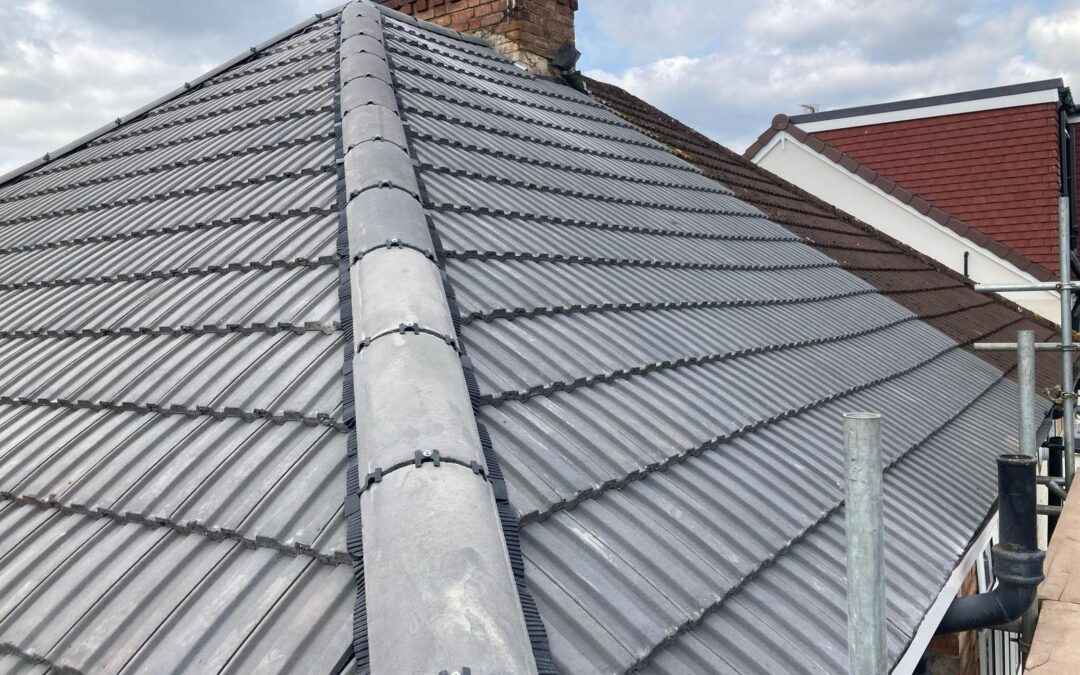
Knowing the signs it’s time to replace your roof instead of repairing it can save you thousands of pounds and protect your home from serious, long-term damage. If you own a property in the UK, your roof works harder than almost any other part of the building. It battles relentless rain, gusting winds, frost, and the occasional summer heatwave, all while quietly keeping your family and belongings dry.
The trouble is, many homeowners struggle to know when a quick repair will do the job and when the whole roof needs replacing. A patch here and a few new tiles there might feel like the sensible, cost-effective choice. However, repeated repairs on an ageing or badly damaged roof often cost more in the long run than a proper replacement would.
The UK’s housing stock is older than most. Many homes were built decades ago, with roofs that have already outlived their expected lifespan. Add in our famously unpredictable weather, and it’s no surprise that roofs across Britain are failing at an alarming rate. Persistent damp, water ingress, and storm damage all take their toll over time.
In this guide, we’ll walk you through the clearest warning signs that point towards full replacement rather than another temporary fix. You’ll learn how roof age, widespread damage, leaks, sagging timber, and rising repair costs all factor into the decision. By the end, you’ll feel far more confident about what’s happening above your head.
At Property Restoration Service, we’ve helped countless homeowners, landlords, and property managers make the right call. If you’re already noticing trouble, our team of trusted roofing contractors UK can carry out a thorough roof inspection and give you honest advice. Let’s start by clearing up one of the most common points of confusion.
Understanding Roof Repair vs Roof Replacement
Before we look at the warning signs, it helps to understand the difference between repairing and replacing a roof. The two are not interchangeable, and choosing the wrong one can leave you out of pocket.
A roof repair tackles a specific, isolated problem. Think of a handful of slipped tiles after a storm, a small leak around a chimney, or a damaged section of flashing. When the rest of the roof is sound, repairs make perfect sense. They’re quicker, cheaper, and restore the roof to good working order.
A roof replacement, on the other hand, involves stripping the existing covering and often the underlayment, then fitting a brand-new roof. This is the right route when problems are widespread, the roof is old, or repeated repairs simply aren’t holding up.
So when are repairs enough? As a rule of thumb, if damage affects less than around 25% of the roof and the underlying structure is healthy, a targeted repair usually does the trick. A leaking valley or a few cracked slates rarely justify a full replacement on their own.
However, the picture changes when issues keep returning or spreading. If you find yourself calling out a roofer every few months, the underlying problem is rarely solved by another patch. That’s typically the moment professional roof replacement becomes the smarter investment.
The key is an honest assessment. Our roof replacement experts will never push you towards a full job when a repair will genuinely last. Understanding roof repair vs replacement properly means you only spend money where it counts.
Roof Age and Why It Matters
One of the biggest factors in deciding when to replace a roof is its age. Even the best-maintained roof has a finite lifespan, and pushing it too far invites trouble.
In the UK, the typical lifespan of a roof depends heavily on the materials used. Here’s a rough guide:
- Concrete tiles: 40 to 60 years
- Clay tiles: 50 to 100 years
- Natural slate: 80 to 100 years or more
- Felt flat roofs: 10 to 20 years
- EPDM rubber flat roofs: 25 to 30 years
These figures assume good installation and reasonable maintenance. In reality, harsh weather and neglect often shorten them considerably.
Why do ageing roofs fail so suddenly? For years, an old roof can look perfectly fine from the ground. Underneath, though, the underlayment may be breaking down, fixings may be corroding, and timbers may be quietly weakening. Then one strong storm comes along, and what seemed solid gives way in a matter of hours.
A common UK example is a 1960s or 1970s semi with its original concrete tiles. By now, those tiles have absorbed decades of moisture, lost their protective coating, and become brittle. Even if individual tiles look intact, the whole system is reaching the end of its life.
If your roof is approaching or has passed its expected age, that’s one of the clearest roof replacement signs UK homeowners should heed. Rather than waiting for failure, it’s worth arranging a professional new roof installation before the next bad winter arrives.
Widespread Damage Across the Roof
A single problem area can usually be fixed. Widespread damage tells a very different story, and it’s one of the strongest signs it’s time to replace your roof instead of repairing it.
When you spot multiple missing tiles, several leaks in different rooms, or large patches of moss and decay across the whole surface, the issue is no longer localised. It points to a roof that’s failing as a whole rather than in one spot.
Consider what’s actually happening up there. If tiles are slipping in several places at once, the fixings holding them down are likely corroding everywhere. If you have leaks in more than one location, the waterproof layer beneath the tiles has probably broken down across large areas. This is classic underlayment failure.
Structural concerns often follow widespread surface damage. Once water gets past the covering in multiple places, it soaks into battens, rafters, and ceiling joists. Over time, this leads to rot, weakened timber, and genuine structural damage that’s expensive to put right.
Take a terraced property where one section has been patched repeatedly. Each patch holds for a while, then water simply finds the next weak point. The homeowner ends up paying for emergency repair after emergency repair, when a single replacement would have solved everything.
When damage spans the roof rather than sitting in one corner, repairs become a game of catch-up you’ll never win. At this stage, our full roof replacement services offer a clean, lasting solution that removes the underlying problems for good.
Persistent Water Leaks and Damp Issues
Few things worry a homeowner more than water coming through the ceiling. Occasional leaks can be repaired, but persistent leaks and damp are a serious red flag.
Internal ceiling stains are usually the first thing people notice. A brown or yellow patch, sometimes ringed and spreading, shows that water is getting in and tracking through the building. If those stains reappear after repairs, the roof is letting you down repeatedly.
Water ingress is particularly damaging in UK homes because of how often it rains. A roof rarely gets a chance to fully dry out, so even small amounts of moisture can build up quickly. Over the months, this leads to damp walls, peeling plaster, and that unmistakable musty smell in the loft.
Damp doesn’t just look unpleasant. It encourages mould growth, which can affect your family’s health and breathing. It also rots structural timber, ruins insulation, and can damage electrics where water reaches wiring in the loft space.
A landlord with a rented property knows this all too well. Persistent damp can breach habitability standards, upset tenants, and lead to disputes. Tackling the root cause with a new roof is often the only way to protect the investment.
If you’ve had the same leak “fixed” two or three times and it keeps returning, the message is clear. The roof covering and underlayment have failed beyond the point of patching. Speaking to property restoration specialists UK early can stop a damp problem becoming a structural disaster.
Sagging Roof Structure or Weak Timber
A flat, even roofline is a sign of good health. A sagging or dipping roof, by contrast, is one of the most serious warning signs you can spot, and it should never be ignored.
What causes a roof to sag? In most cases, it’s water damage to the supporting timbers. When rafters or the ridge beam absorb moisture over a long period, they soften, rot, and lose their strength. The weight of the tiles then pushes the structure downwards.
Other causes include too much weight on the roof, such as old tiles layered over each other, or poor original construction. Whatever the reason, a visible dip means the structure itself is compromised.
How do you spot it? Stand across the road and look along the ridge line. It should run dead straight. If you see a curve, a dip in the middle, or one side pulling lower than the other, that’s structural damage at work. Inside the loft, look for bowed rafters, cracked timbers, or daylight where it shouldn’t be.
The safety risks here are real. A severely sagging roof can, in extreme cases, collapse, particularly under the extra load of heavy snow or pooled rainwater. This is not a problem to put off.
A sagging roof almost always calls for replacement rather than repair, because the timber framework needs attention alongside the covering. Our team of roof replacement experts can assess the structure safely and rebuild it properly. If you’ve noticed any dipping, treat it as urgent.
Damaged or Missing Roof Tiles and Slates
The UK’s weather is brutal on roof coverings. Storm after storm, season after season, tiles and slates take a battering, and eventually they give way.
Storm damage is one of the most common reasons homeowners call us. High winds lift and crack tiles, send slates crashing into the garden, and tear at flashing. After a big storm, it’s well worth checking your roof and clearing your gutters of broken fragments.
A few missing tiles after one storm can be repaired. The problem comes when it keeps happening. If you’re replacing slipped or broken tiles every winter, the whole covering has likely become brittle and the fixings have weakened.
Why do patch repairs fail long-term on an old roof? Matching old tiles is difficult, and new ones sit awkwardly against weathered neighbours. More importantly, each repair only addresses the tiles you can see. The surrounding ones are just as worn and will fail next.
Slates have their own quirks. Over time, the nails holding them rust through in a process called “nail sickness.” When this sets in, slates slip off in growing numbers no matter how many you replace. At that point, re-roofing is the only sensible answer.
Picture a Victorian terrace with original slate. The slates themselves may still be sound, but the fixings have corroded after a century of rain. Spot repairs become endless. Investing in new roof installation services UK ends the cycle and restores full protection.
Rising Repair Costs vs Full Replacement
Money is, understandably, at the heart of most roofing decisions. Repairs feel cheaper because each one is a smaller bill. Over time, though, the maths can tip firmly towards replacement.
Let’s think it through. A single repair might cost a few hundred pounds. That’s clearly less than a full roof. But if you’re paying for three or four repairs a year, plus the damp treatment and redecorating that follow each leak, those costs mount quickly.
A useful way to judge it is this: if your repair bills over two or three years start to approach the cost of a replacement, you’re throwing good money after bad. You’re paying repeatedly without ever solving the underlying problem.
A new roof, by contrast, delivers lasting value. You get fresh tiles or slates, new underlayment, sound timber, and proper fixings, often backed by a guarantee. The ongoing repair bills stop, and your energy efficiency usually improves too, thanks to modern insulation and ventilation.
There’s also the property value angle. For landlords and property managers especially, a sound roof protects the asset, keeps tenants happy, and avoids the disruption of constant call-outs. A tired, patched roof can put off buyers and drag down a valuation.
When repairs stop being worth it, replacement becomes the genuinely economical choice. Our trusted roofing contractors UK will give you a clear, honest comparison so you can weigh up roof repair vs replacement with confidence and no pressure.
Bringing It All Together: When to Replace a Roof
By now, you can probably see how these signs connect. Age weakens the materials, weather exploits the weaknesses, leaks follow, timber suffers, and repair costs spiral. Rarely does just one factor appear on its own.
If you recognise two or more of the issues we’ve covered, it’s well worth getting a professional opinion. A trained eye can tell the difference between a roof with years left in it and one that’s quietly failing.
A proper roof inspection is the best place to start. As emergency property repair experts, we assess the covering, the structure, the loft, and the gutters, then explain exactly what we find in plain English. No jargon, no scare tactics, just honest advice.
Conclusion
Spotting the signs it’s time to replace your roof instead of repairing it early can spare you enormous stress, expense, and disruption down the line. Let’s recap the key warning signs to watch for.
Your roof likely needs replacing rather than repairing if it has reached or passed its expected age, shows widespread damage across the surface, suffers persistent leaks and damp, displays a sagging or dipping structure, sheds tiles or slates repeatedly, or keeps demanding costly repairs. The more of these you tick off, the stronger the case for full replacement.
There’s a real urgency here. UK weather doesn’t wait, and a roof that’s already struggling will only get worse with the next storm or hard frost. Acting now, before a small problem becomes a structural emergency, is always cheaper and safer.
If any of these roof replacement signs UK homeowners should know sound familiar, don’t put it off. Request a thorough roof inspection and book a roof replacement quote so you know exactly where you stand.
At Property Restoration Service, our experienced team carries out honest assessments and delivers high-quality work you can rely on. Whether you need advice or a complete re-roof, our professional new roof installation service has you covered. Get in touch today and protect your home before the next downpour.
Frequently Asked Questions
How do I know if my roof needs replacing or repairing?
If damage is isolated, such as a few slipped tiles or one small leak, a repair usually suffices. Replacement becomes the better option when problems are widespread, the roof is old, you have persistent damp, or you’re paying for repeated repairs. A professional roof inspection gives you a clear answer.
How long does a UK roof last?
It depends on the material. Concrete tiles last around 40 to 60 years, clay tiles 50 to 100 years, and natural slate can exceed 100 years. Felt flat roofs typically last 10 to 20 years. Weather and maintenance affect these figures, so older roofs should be checked regularly.
What are the first signs of roof failure?
Early warning signs include damp patches or stains on upstairs ceilings, missing or cracked tiles after storms, granules or fragments collecting in your gutters, daylight visible in the loft, and a musty smell from the roof space. Catching these early often means a smaller, cheaper job.
Is roof replacement more cost-effective than repairs?
In the short term, repairs are cheaper. However, if you’re paying for repeated repairs plus damp treatment and redecorating, those costs add up fast. When ongoing repair bills start approaching the price of a new roof, replacement becomes the more cost-effective choice, with lasting protection and often a guarantee.
Does insurance cover roof replacement in the UK?
Buildings insurance usually covers sudden, accidental damage, such as storm damage or a fallen tree, but not wear and tear or gradual deterioration. If your roof has simply aged or been poorly maintained, the cost generally falls to you. Always check your policy and report storm damage promptly.
How quickly should I act if I notice a sagging roof?
Treat a sagging roof as urgent. It usually indicates rotten or weakened timber and can pose a genuine safety risk, especially under snow or heavy rain. Arrange a professional assessment as soon as possible, as the structure as well as the covering will likely need attention.
Can I replace just part of my roof?
Sometimes, yes, particularly on larger or split-level properties. However, partial replacement can leave you with mismatched tiles and uneven wear, where old sections fail soon after. For ageing or widely damaged roofs, a full replacement usually offers better value and a more reliable, watertight result.